
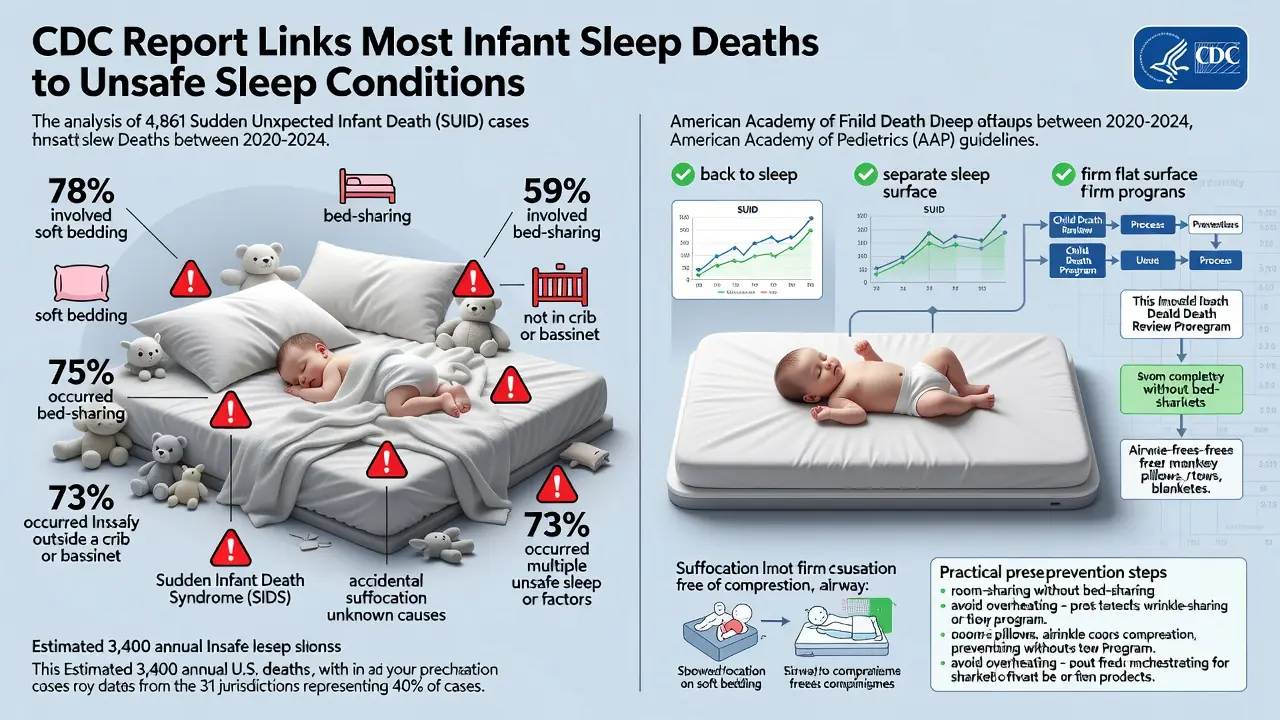
A new CDC analysis of nearly 4,900 sudden unexpected infant deaths from 2020 through 2024 found that most cases involved risky sleep environments. The findings give parents and caregivers a concrete reason to review where and how babies sleep, even during a routine nap or bedtime.
What the CDC counted as a sudden unexpected infant death
The Centers for Disease Control and Prevention uses the term sudden unexpected infant death, or SUID, for several categories. These include deaths attributed to sudden infant death syndrome (SIDS), accidental suffocation or strangulation in bed, and deaths whose causes remain unknown. The CDC estimates that about 3,400 infants younger than 1 year die from SUIDs in the United States each year.
How the data was collected
Researchers analyzed 4,861 cases recorded between 2020 and 2024 in the CDC's Sudden Unexpected Infant Death and Sudden Death in the Young Case Registry. Unlike standard death certificates, the registry draws on child death review programs and includes details about sleep environments, medical examinations and death scene investigations. The analysis covered 31 participating jurisdictions, representing about 40% of SUID cases nationwide, so the results describe a large share of cases but not every death in the country.
What the findings show about sleep conditions
Two-thirds of the deaths involved infants between birth and 3 months old. The researchers found that 78% of infants had soft bedding in their sleep environment, 59% were sharing a sleep surface, and 75% were sleeping somewhere other than a crib, portable crib or bassinet. At least 73% of cases involved unsafe sleep factors.
That figure does not mean every death was conclusively caused by the sleep environment. Some deaths remained unexplained, and the researchers noted that medical or genetic factors may also play a role. Among 919 deaths classified as explained suffocation with unsafe sleep factors, soft bedding was the most frequently identified mechanism. Airway obstruction information was unknown or missing in a substantial share of cases, which limits how precisely investigators can attribute each death.
Practical steps for families
The American Academy of Pediatrics recommends placing babies on their backs to sleep, on a firm, flat surface of their own, without soft bedding. In practice, that means:
- Placing the baby on the back for every sleep, including naps.
- Using a firm, flat, separate sleep surface such as a crib, portable crib or bassinet.
- Keeping blankets, pillows and other soft items out of the sleep area.
The researchers say better documentation and continued investigation of both sleep-related and medical causes could help public health officials design more effective prevention strategies.