
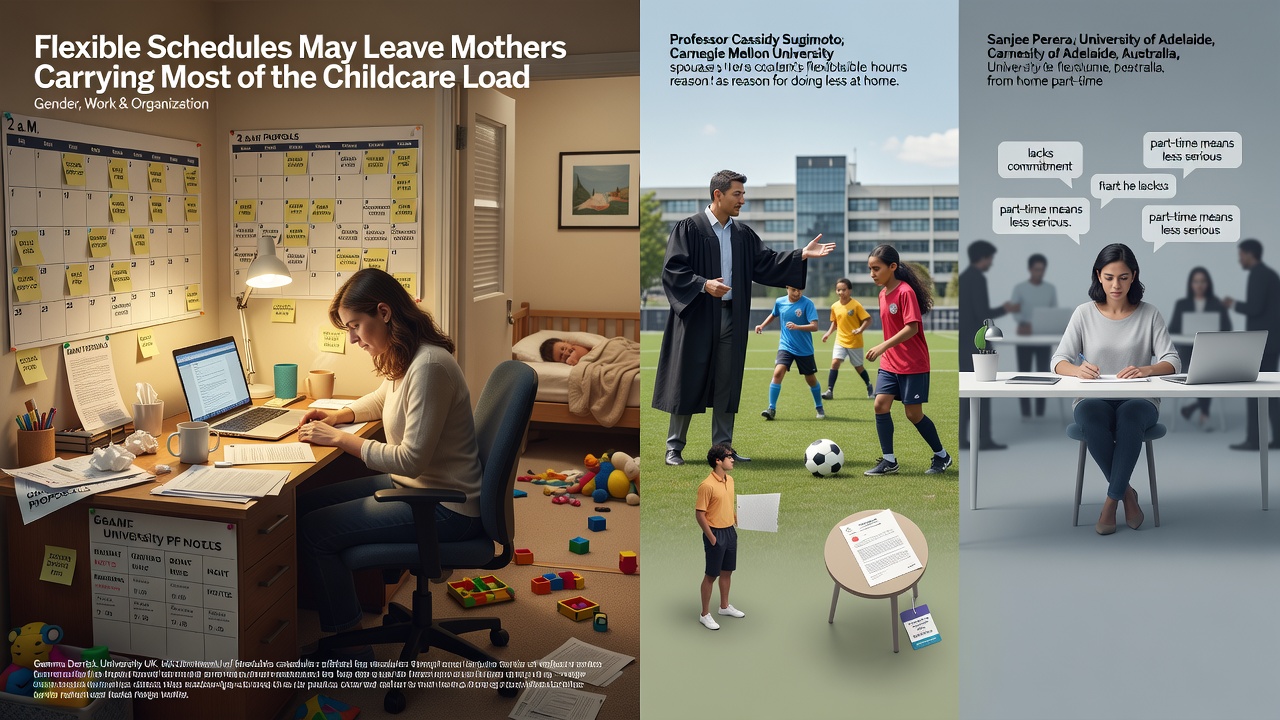
A new international study suggests that the flexibility meant to help academic parents balance work and family can end up concentrating childcare duties on women. The findings draw on survey data from more than 10,000 academic professionals with children, along with follow-up interviews that point to why the imbalance persists.
What the research found
The team, which included Gemma Derrick of the University of Bristol in the United Kingdom and Professor Cassidy Sugimoto of Carnegie Mellon University in the United States, examined how childcare was divided among parents working in universities and research institutions. Their earlier survey, published in 2022 in Scientific Reports, found that women were more likely than men to take primary responsibility for children. Even when couples described sharing childcare equally, or when women held a supporting role, women still carried more of the work than men in the same arrangement. Derrick noted that coaching children's sports teams was the one task men consistently took on more than women.
The newer analysis, published in Gender, Work & Organization, examined why flexibility seems to shift the burden. Women who had flexible hours, such as adjustable commuting times, tended to use that freedom for childcare. Some men said their spouses' flexible schedules were the reason they did less childcare, and some noted that their partners had chosen careers that made it easier to adjust time for the children.
How the pattern plays out day to day
Interviews with female researchers describe how flexibility can translate into constant availability. One British researcher said her husband considered her always available for the children because her hours were flexible. A researcher in the United States described taking her child to and from school, preparing meals and attending activities during the day, then working until midnight or 2 a.m. to finish her professional tasks. She said she could set her hours freely, but the amount of work did not shrink.
A separate study by Guo Xin Ma of the Royal Agricultural University and colleagues, published in 2025 in the European Journal of Higher Education, interviewed 26 female academics in the United Kingdom. Some described feeling judged as less committed when they worked from home, left early or worked part-time. Others said they could not fully rest during vacations because no one else could cover their responsibilities.
Social expectations on both sides
Men who want a bigger share of childcare also face resistance. Derrick said male academics who use flexible arrangements for their children often encounter derogatory comments or career setbacks. The assumption that childcare is naturally a mother's job limits choices for both women and men.
Sanjee Perera of the University of Adelaide in Australia describes this as "the illusion of flexibility in academia." Researchers may control when they work, but they still face heavy demands such as writing papers, securing grants, mentoring students, teaching and attending conferences, which can crowd out the time that flexibility seems to offer.
Limits of the evidence
The studies rely on surveys and interviews within academia, so their results may not apply directly to every workplace or household. The research describes patterns and experiences rather than measuring cause and effect across all families. Still, the consistency across the two studies suggests that flexible policies alone do not guarantee a fairer division of home responsibilities, and that workplace expectations and social norms shape how that flexibility is used.