
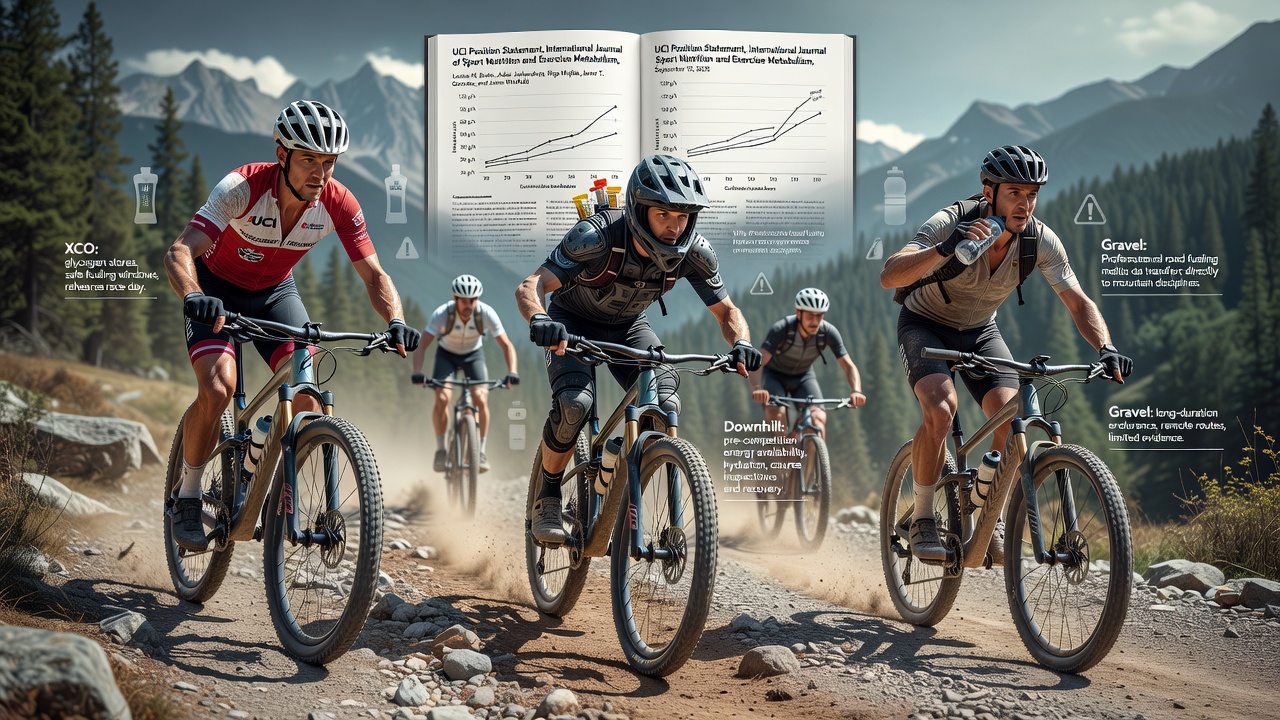
Cyclists who race cross-country, downhill and gravel all pedal bikes, yet their race-day nutrition needs can differ sharply. A new position statement from the Union Cycliste Internationale (UCI) makes that point with unusual depth, drawing on 14 scientific reviews and contributions from 54 researchers. The document, published September 15, 2026, in the International Journal of Sport Nutrition and Exercise Metabolism, argues that one generic carbohydrate target does not fit every type of cycling.
Discipline Determines the Fueling Strategy
The project, led by Louise M. Burke with input from Asker Jeukendrup, Iñigo Mujika and Javier T. Gonzalez, identifies physiological differences and practical constraints that separate one discipline from another. Cross-country (XCO) racing combines sustained high effort with frequent surges on climbs, so good glycogen stores at the start matter. Technical sections, however, can make drinking or eating difficult, which makes it important to find safe fueling windows and rehearse them before race day.
Downhill racing calls for a different approach. Competitive runs are short, so eating heavily while descending is rarely practical. The statement points instead to energy availability before competition, hydration, and the demands of course inspections, qualifying runs and recovery between sessions. This comparison describes the nature of downhill racing and is not a quantified recommendation for every rider.
Gravel racing shares the long-duration demands of endurance events but adds remote routes and sections where eating could interfere with bike handling. A review by Jamie Whitfield, Iñigo Mujika and Louise Burke states plainly that scientific evidence on gravel-specific nutrition remains limited. The authors drew on athlete interviews and findings from other endurance sports to examine current practice.
What Professional Road Numbers Do and Do Not Mean
Road cycling has a deeper research base. A review led by Jeukendrup reports that carbohydrate intake during racing has risen from roughly 30 to 60 grams per hour before 2010 to 90, 120 grams or more per hour among some professional riders today. Those figures describe elite practice in a specific context, with higher early-race intensity and extensive gut training that helps riders tolerate large intakes. They are not universal targets.
Applying those numbers to a recreational mountain bike event or a short XCO race could produce a plan that does not match the rider's needs. Duration, intensity, fitness, digestive tolerance and access to food all matter together. Eating more carbohydrate does not automatically improve performance if the effort's energy demands are already being met.
Practical Implications and Open Questions
For everyday riders, the practical lesson is to build a fueling plan around the specific ride or race rather than a single number. An easy two-hour outing, a cross-country race and a long gravel event may each call for a different approach, and temperature, elevation gain and personal tolerance should shape the plan. Riders should also avoid chronically under-eating. The researchers note that consistently low energy intake can impair recovery, training adaptation and several physiological functions, a concern that is especially relevant where body weight influences performance.
The statement also cautions that evidence quality varies by discipline. Junior, adult and Masters cyclists may have different needs, and sex and age are part of the picture. Recommendations for emerging formats such as gravel rest partly on evidence from other sports and need further testing. Mountain biking and other off-road disciplines are named as priorities for new research, which should clarify which road-based strategies transfer directly and which do not.